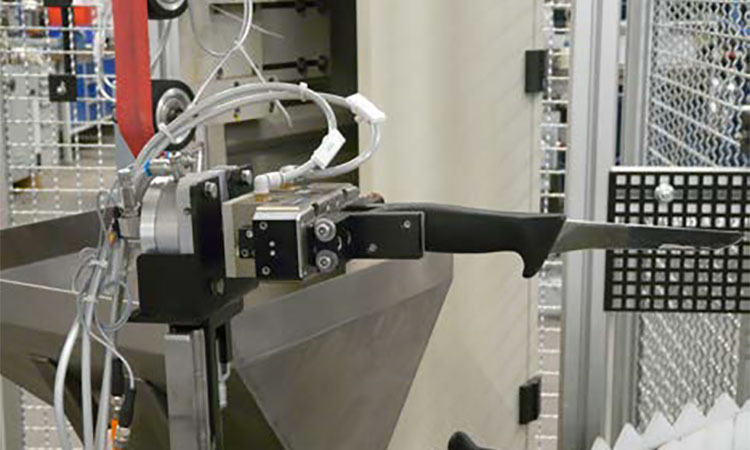
The CNC machines and robot cells of the Berger Group grind and sharpen (almost) everything that needs
to be permanently sharp. Solenoid interlocks, control panels and safety controllers from Schmersal are
used for position monitoring and interlocking of the safety doors on the robot cells.
In the kitchen, in the field, in food production and also in the operating theatre: wherever sharp cuts are made, the knives have often been ground, sharpened or serrated by machines from the Berger Group. The company is literally a “hidden champion” because it is based in a small town on the banks of the
River Wupper – not far from the “blade city” of Solingen, a traditional centre of the cutlery industry. Today, Berger is internationally positioned and sells machines to 70 countries, and in considerable quantities. In addition to CNC-controlled processing machines, numerous robot cells can also be seen in the final assembly area.
Safeguarding the danger zones
When selecting robot brands, Berger is guided entirely by the customer’s requirements. However, when it comes to safeguarding the danger zones and designing the man-machine interface on the safety doors, the company is committed to the programme developed by the Schmersal Group for this task. And not only the manufacturer, but also the series are standardised. If, as is often the case in robotic cells, guard doors must not be opened while hazardous movements continue, electronic solenoid interlocks from the AZM 40 series are used. They are extremely compact and can therefore be easily integrated into the surrounding structure, thanks to the 180° angular flexibility of the equally compact actuator. Important for standardisation: All
application variants (left/right hinged doors, swing doors and sliding doors) can be covered with a single design. Another practical advantage is the bistable guard locking system, which retains the last locking status if the power supply is interrupted, so that the guard remains closed.
Operation: Directly on the safety door
The BDF200 control units are used as the human-machine interface for the main operating functions of the robotic cells developed by Berger – emergency stop, unlocking, resetting the solenoid interlock. Like the solenoid interlocks, they can be easily mounted on the 40 mm profiles of the fencing. Other advantages include easy connection using M12 connectors, the robust design of the housing and switches, and the arrangement of the operating elements directly on the guard door, with a clear view of the automated work process.
Profisafe compatible safety controllers
The Berger Group also relies on standard concepts for safe signal evaluation – and on Schmersal. Markus Lütje, development engineer and certified safety engineer, responsible for machine safety at Berger: “If customers want a ‘safety-separated’ concept with its own safety controller, we implement this with the PROTECT PSC1”. Depending on the robot cell type and task, expansion modules from the PROTECT PSC1 series are also used. And the integration options of these safety controllers are also used intensively: “If we can choose the robot manufacturer, we use ABB robots. With their SafeMove monitoring software, for example, collaborative robot cells can be implemented with inherent safety. However, the safety controller must be PROFIsafe compatible, and that is the PROTECT PSC1.
First measure – then sharpen
During a tour of the final assembly area, Markus Lütje uses a number of robot cells to demonstrate how the safety concept is implemented in practice with the Schmersal range – starting with a cell with two belt grinding stations for sharpening butcher’s knives. “We produce cells like this very often and many knife manufacturers all over the world use them”. First, each blade that the robot removes from a rotary indexing magazine is measured. The measurement data is used to determine the subsequent grinding process to an accuracy of 1/100 mm. The blade is processed twice on both sides – first the pre-grinding, then the fine grinding. The result: the blade is sharp and is returned to the magazine. A solenoid interlock and a control unit are mounted on each of the cell’s safety doors, while a PROTECT PSC1 provides safe signal evaluation.
Precise and flexible grinding
Another robot cell that is currently being completed at Berger requires particular flexibility. Its task is to grind combine harvester knives, and each cutter bar is fitted with knives of the same basic shape but with
different grinding on one, two or three sides and with or without toothing. To ensure that the mower runs smoothly without imbalance, the weight of each blade is precisely defined. This is why the knives are not only measured before grinding, but also weighed and the weight of the material removed is determined beforehand. After the grinding process, each knife is weighed and, if necessary, reworked until not only the grinding pattern but also the weight is correct. Here too, the combination of AZM40, BDF200 and PROTECT PSC1 ensures safety and transparency.
Easy to integrate add-on modules
A third robot cell is even more flexible in terms of function and size. It processes very small multi-tool blades, which are stored as bulk material and separated on a vibrating conveyor. The robot, guided by a camera, picks up an individual blade and guides it to the grinding system. The highly complex contour of the multitool is then deburred. And that’s not all. Markus Lütje: “Depending on requirements, the user can dock a polishing station and integrate it into the process”. The enclosure, including safety doors and AZM40
solenoid interlocks, is then expanded in a modular fashion. The PROTECT PSC1 safety controller is prepared for both operating modes – with and without a polishing station and additional safety doors.
Customisable standard
For some machine series, Berger also uses safety sensors from the Schmersal portfolio, as well as the non-contact solenoid interlock MZM100. The Schmersal range therefore offers everything the Berger Group needs to protect safety doors – both on the robot cells and on the CNC machines for grinding, polishing, sharpening and gear cutting that the company also develops and manufactures – and which, like the robot cells, are used worldwide in the production of cutlery.