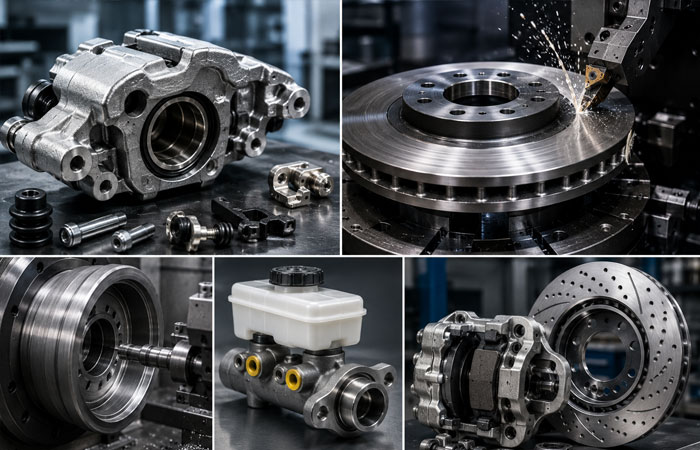
The braking system is one of the most safety-critical assemblies in every automobile. Whether in an internal combustion engine (ICE) vehicle, hybrid, or electric vehicle (EV), braking components must deliver absolute reliability under extreme operating conditions. Every brake caliper, disc rotor, brake drum, and master cylinder depends on precision machining to achieve flawless performance. Even a slight deviation in geometry, runout, or surface finish can lead to brake noise, vibration, reduced stopping efficiency, or premature wear.
The global automotive brake system market is projected to exceed USD 42 billion by 2030, growing at a CAGR of around 5–6%, driven by rising vehicle production, increasing adoption of Advanced Driver Assistance Systems (ADAS), and stricter vehicle safety regulations. Meanwhile, the global automotive disc brake market alone is expected to surpass USD 18 billion during the same period. This growth continues to generate significant demand for high-precision machining technologies across the automotive manufacturing ecosystem.
Brake Calipers: Precision Under Pressure
Brake calipers convert hydraulic pressure into clamping force, pressing the brake pads against the disc rotor. Modern aluminium brake calipers are increasingly replacing cast iron to reduce vehicle weight while maintaining strength.
Calipers undergo multiple machining operations including CNC milling, drilling, tapping, precision boring, seal groove machining, and mounting face finishing. Bore diameters often require tolerances within ±10 microns, ensuring smooth piston movement and leak-free hydraulic operation.
Disc Brakes: The Need for Perfect Geometry
Disc brake rotors remain among the most frequently machined automotive components. Typically manufactured from grey cast iron or carbon composite materials, brake discs undergo turning, drilling, slotting, balancing, and double-disc grinding operations.
Modern passenger vehicle brake discs generally have lateral runout below 30–50 microns, while premium vehicles often target less than 20 microns. Surface finish is equally critical, with braking faces typically maintained between Ra 1.2 and 2.5 μm to ensure uniform pad contact, reduced brake noise, and consistent friction performance.
Brake Drums and Master Cylinders
Although disc brakes dominate passenger vehicles, brake drums continue to be widely used in commercial vehicles and rear axles of compact cars due to their durability and cost-effectiveness. Drum machining includes turning, boring, facing, and balancing to achieve concentricity and consistent braking performance.
The master cylinder, which generates hydraulic pressure throughout the braking system, requires ultra-precise boring, honing, and surface finishing. Cylinder bore roundness and straightness are typically controlled within 5–10 microns, ensuring smooth piston travel and long seal life.
Quality Challenges Define Brake Manufacturing
Unlike many automotive components, brake parts operate under direct safety requirements. Therefore, machining quality is non-negotiable.
Surface Finish: Brake rotors, caliper bores, and master cylinders require controlled surface roughness to optimize friction, sealing performance, and wear characteristics. Inconsistent finishes can cause brake judder, excessive wear, or hydraulic leakage.
Runout Control: Excessive lateral runout is one of the primary causes of brake pedal pulsation and vibration. Precision turning, grinding, balancing, and in-process measurement systems help maintain rotor runout within extremely tight tolerances.
Dimensional Precision: Modern CNC machining centres, automatic gauging systems, and coordinate measuring machines (CMMs) routinely inspect critical brake components with accuracies below 5 microns, ensuring consistent product quality throughout mass production.
Advanced Machining for the Future
The evolution of braking technology is driving significant advances in machining. High-speed CNC machining, robotic automation, adaptive tooling, and AI-enabled process monitoring are improving productivity while reducing scrap and machine downtime. At the same time, electric vehicles are introducing larger regenerative braking systems, corrosion-resistant brake discs, lightweight aluminium calipers, and advanced coated rotors that demand even tighter machining tolerances.
For machine tool builders, cutting tool manufacturers, metrology companies, and automotive suppliers, brake system machining represents one of the most quality-sensitive applications in modern manufacturing. As vehicles become faster, smarter, and safer, precision machining will continue to play a decisive role in delivering braking systems that protect millions of lives on roads across the world.