Despite the global shift toward electrification, the internal combustion engine (ICE) remains the largest consumer of precision machining worldwide. According to industry estimates, more than 75 million passenger and commercial vehicles will be produced globally in 2026, and nearly 80% of them will still feature either conventional ICE or hybrid powertrains. While electric vehicles continue to grow rapidly, hybrid vehicles—which combine an ICE with an electric motor—are ensuring sustained demand for precision engine components.
The global automotive engine market is estimated at USD 110–120 billion, while automotive machining accounts for nearly 35–40% of total machine tool consumption worldwide. Every engine contains 150–250 precision-machined surfaces, requiring dimensional accuracies as tight as 5–20 microns, making engine manufacturing one of the most demanding machining applications.
Precision Starts with the Engine Block
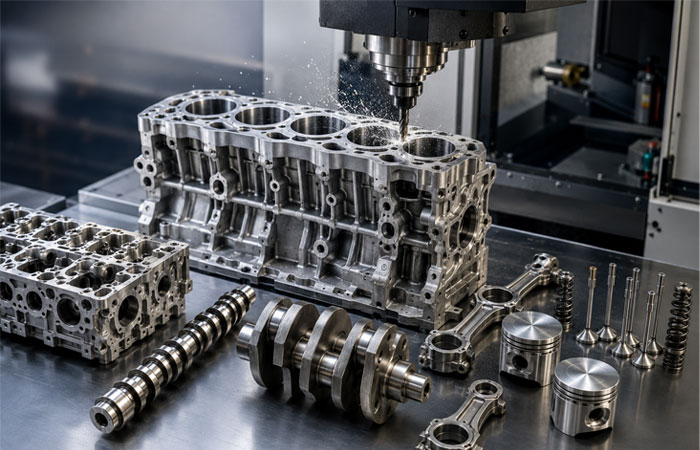
The cylinder block remains the foundation of every engine. Manufactured primarily from aluminium alloys and compacted graphite iron (CGI), it undergoes multiple machining operations including face milling, boring, drilling, tapping and plateau honing. A typical four-cylinder engine block requires 40–60 machining operations before assembly.
The cylinder head has become increasingly sophisticated with integrated exhaust manifolds, turbocharger interfaces and optimized cooling passages. Five-axis machining centres now complete multiple operations in a single setup, reducing production time by 20–30% while improving geometric accuracy.
High-Accuracy Rotating Components
The crankshaft is among the most critical rotating components in an engine. It undergoes CNC turning, pin milling, deep-hole drilling, induction hardening, grinding and super-finishing. Journal roundness is typically maintained within 2–5 microns, while surface roughness is often below Ra 0.2 μm.
Similarly, camshafts require ultra-precise profile grinding to ensure accurate valve timing. Modern CNC cam grinders equipped with in-process measurement systems achieve profile accuracies of less than 3 microns.
Connecting rods are increasingly manufactured using fracture-split technology, ensuring perfect cap alignment and reducing assembly errors. Precision boring and honing guarantee accurate piston motion while supporting higher combustion pressures in modern turbocharged engines.
The valve train—including rocker arms, tappets, valve seats and valve guides—requires fine grinding, hard machining and precision finishing to withstand engine speeds exceeding 6,000 rpm in passenger vehicles.
Manufacturing Trends Driving the Industry
Automotive engine machining is undergoing rapid technological transformation.
Dry machining is replacing conventional flood coolant for many cast iron operations, reducing coolant consumption by up to 90%, lowering operating costs and improving sustainability. Advanced PVD- and CVD-coated carbide tools now withstand the elevated cutting temperatures while maintaining long tool life.
High-speed machining (HSM) has become the preferred process for aluminium engine components. Spindle speeds exceeding 20,000 rpm and optimized tool paths reduce cycle times by 25–40%, while delivering superior surface finish and dimensional consistency.
Artificial Intelligence is emerging as the next competitive advantage. AI-driven machining systems continuously analyse spindle load, vibration, temperature, power consumption and tool wear to optimise machining parameters in real time. Predictive maintenance alone can reduce machine downtime by 30–50%, while increasing Overall Equipment Effectiveness (OEE) by 10–20%.
The Road Ahead
Although electrification is reshaping global mobility, ICE manufacturing is evolving—not disappearing. Downsized turbocharged engines, hybrid powertrains and alternative fuels continue to demand highly efficient, lightweight and precision-machined components.
For the machining industry, this evolution represents a long-term opportunity. Companies investing in high-speed machining, intelligent automation, AI-enabled manufacturing, digital metrology and advanced cutting technologies will lead the next generation of engine production. The future of automotive machining lies not only in producing components faster, but in manufacturing them with greater precision, higher productivity and sustainable efficiency.