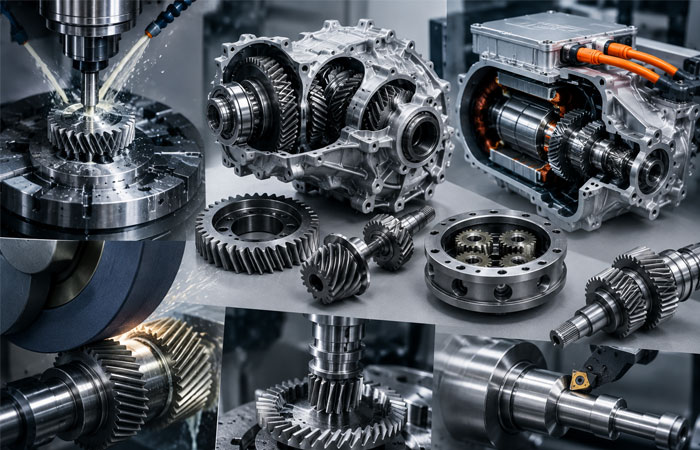
The transmission system has always been one of the most precision-intensive assemblies in an automobile. As the automotive industry transitions toward electric mobility, gear manufacturing is not disappearing—it is evolving. While battery electric vehicles (BEVs) eliminate multi-speed transmissions, they still rely on highly precise reduction gearboxes, planetary gear sets, differential gears and integrated e-axles that operate at significantly higher rotational speeds. This makes transmission and gear machining one of the fastest-growing opportunities for the global machining industry.
According to industry estimates, the global automotive transmission market is expected to exceed USD 95 billion by 2030, while the global automotive gear market is projected to surpass USD 55 billion, driven by growing demand for hybrid and electric vehicles. Modern EV motors operate at 12,000–20,000 rpm, with some premium platforms exceeding 22,000 rpm, placing unprecedented demands on gear accuracy, surface finish and noise reduction.
Precision Gearboxes for Electric Vehicles
Unlike conventional vehicles that use multi-speed gearboxes with hundreds of moving parts, most EVs employ a single-speed reduction gearbox. However, the simplicity of design increases machining complexity. High-speed gears require micron-level accuracy to minimise Noise, Vibration and Harshness (NVH) while ensuring maximum power transmission efficiency.
Gear profile accuracy in modern EV transmissions is typically maintained within 3–5 microns, while gear surface roughness is controlled below Ra 0.2 μm to reduce friction and improve durability.
Differential and Planetary Gears
Differential gears remain critical in passenger vehicles, SUVs, commercial vehicles and electric platforms. These bevel gears distribute torque efficiently between wheels while operating under high loads. Precision gear cutting followed by grinding and lapping ensures smooth power delivery and extended service life.
Planetary gears are increasingly becoming the backbone of hybrid transmissions and electric drive systems due to their compact design and high torque density. A typical planetary gear set consists of a sun gear, planet gears, carrier and ring gear, all requiring highly accurate tooth geometry to achieve quiet operation and maximum efficiency.
E-Axles: The Integrated Future
The emergence of e-axles represents the biggest transformation in drivetrain manufacturing. By integrating the electric motor, reduction gearbox, differential and power electronics into a single compact unit, e-axles reduce vehicle weight while improving packaging efficiency.
Industry analysts expect the global e-axle market to grow at a CAGR exceeding 20% through 2030 as electric vehicle production accelerates. This creates enormous opportunities for machining centres, gear-cutting machines, grinding systems, metrology equipment and advanced cutting tools.
Advanced Gear Machining Technologies
Modern transmission manufacturing depends on highly specialised machining technologies.
Gear grinding delivers the highest tooth profile accuracy and surface finish after heat treatment. CNC gear grinders equipped with automatic measurement systems achieve profile deviations below 5 microns, making them ideal for premium automotive transmissions.
Gear honing has become increasingly popular for EV gears because it significantly reduces transmission noise while improving tooth surface quality and extending gear life.
Power skiving is replacing conventional shaping for internal gears. The process enables simultaneous rotation of tool and workpiece, reducing machining time by 30–50% while delivering superior productivity for planetary gear manufacturing.
Hard turning is increasingly replacing finish grinding for hardened gear components. Using advanced CBN inserts, manufacturers achieve excellent dimensional accuracy while reducing process steps, production costs and machine footprint.
The Road Ahead
As automotive powertrains become quieter, faster and more compact, the demand for ultra-precision gear machining continues to rise. Future transmissions will require even tighter tolerances, improved surface integrity and greater manufacturing flexibility.
For machine tool builders, cutting tool manufacturers, gear specialists and metrology companies, transmission machining is entering a new era where digital manufacturing, automation and advanced machining technologies will define competitiveness. Whether powering an ICE vehicle, hybrid system or next-generation EV, precision gears will remain at the heart of automotive mobility—and precision machining will remain the technology that makes them possible.