In the age of electric mobility, the battery enclosure has emerged as the most critical structural component of an electric vehicle. Much like the engine block defined vehicle engineering in the internal combustion era, today’s EV battery housing has become the central element around which performance, safety, and manufacturing precision revolve. Far beyond being a simple protective casing, modern battery enclosures are highly engineered structures designed to deliver crash protection, thermal stability, leak-proof sealing, and lightweight performance simultaneously.
As EV manufacturers compete to increase vehicle range and efficiency, lightweight construction has become a top priority. This has led to the widespread adoption of thin-wall aluminum battery trays manufactured from high-strength alloys such as 6061-T6 and 7075. These materials provide an ideal balance of strength and weight reduction, helping automakers maximize battery performance without adding unnecessary mass to the vehicle.
However, machining these thin-wall structures is far from straightforward. Unlike conventional heavy components, battery housings are extremely sensitive to thermal distortion and vibration during machining. Insufficient rigidity often results in wall deformation, chatter marks, dimensional inaccuracies, and compromised surface quality. Even minor inconsistencies can affect sealing performance and structural reliability.
To overcome these challenges, manufacturers are increasingly shifting away from conventional heavy-cut milling approaches and adopting High-Speed Machining (HSM) strategies. HSM focuses on precision-oriented, low-force cutting techniques that reduce stress on delicate aluminum structures while maintaining productivity.
One of the key strategies involves optimized cutting parameters. Machinists now rely on lighter radial engagement, typically between 20% and 40% of the tool diameter, along with shallow axial cuts of less than 0.5 mm. These settings significantly reduce lateral cutting forces and minimize the risk of deformation during machining.
Another major advancement is the use of adaptive toolpath strategies. Techniques such as climb milling and segmented machining paths help distribute heat and stress evenly across the workpiece. This not only improves dimensional stability but also enhances surface finish and tool life.
Fixturing technology has also evolved to support these delicate operations. Traditional rigid clamping methods are increasingly being replaced with soft jaws and vacuum fixtures that evenly distribute holding pressure. These advanced fixtures prevent localized deformation while ensuring stable positioning throughout the machining cycle.
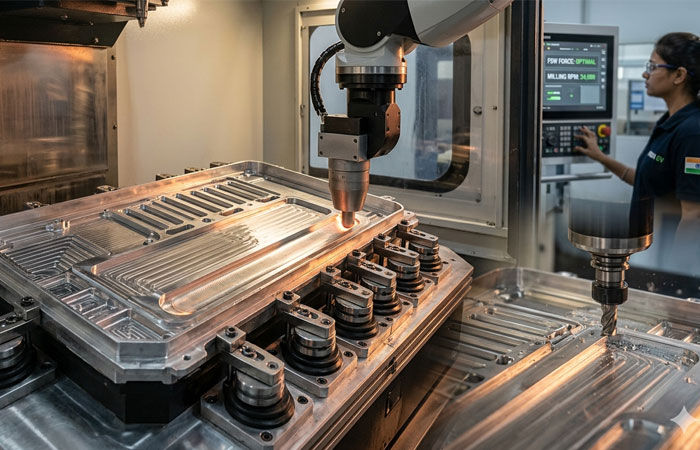
Alongside machining innovations, EV manufacturers are also transforming the way battery enclosures are assembled. A major breakthrough has been the growing adoption of Friction Stir Welding (FSW). Unlike traditional fusion welding processes that melt the material, FSW is a solid-state joining technique that mechanically “stirs” metals together under controlled pressure and heat.
This process offers several critical advantages for EV battery trays. FSW creates extremely strong, leak-proof joints with virtually zero porosity while generating minimal thermal distortion. Since the material does not melt, the original mechanical properties of the aluminum are largely preserved. Additionally, the process eliminates the need for filler materials, helping reduce overall component weight.
To further improve manufacturing precision, many companies are investing in advanced 5-axis integrated machining centers. These systems enable complete “single-setup” manufacturing where milling, drilling, tapping, and finishing operations are performed in one clamping cycle. Reducing part handling minimizes tolerance stack-up and ensures exceptionally tight flatness tolerances, often within ±0.005 mm.
As EV production continues to expand globally, battery enclosures have become a true benchmark of machining capability. Success in this demanding segment requires manufacturers to move beyond traditional high-force machining practices and embrace a precision-driven philosophy where aluminum is treated not merely as a material, but as a critical structural skin that defines the future of electric mobility.