The electric vehicle industry is undergoing one of the biggest manufacturing transformations in automotive history through the rise of giga-casting. Popularized by leading EV manufacturers, giga-casting replaces dozens of individual chassis components with a single large aluminum casting, dramatically simplifying vehicle assembly while reducing weight, production time, and manufacturing costs.
What once required hundreds of welded parts can now be produced as one integrated structural component. However, while giga-casting has revolutionized automotive production, it has also introduced a new generation of machining challenges. These giant castings—often as large as an entire vehicle floor or rear body structure—still require extremely precise post-process machining to meet automotive-grade tolerances and assembly standards.
Machining giga-cast components is unlike conventional metalworking. These parts are not only massive in size but also structurally complex, featuring thin walls, deep pockets, ribbed sections, and multiple critical mounting points. Maintaining dimensional accuracy across such a large surface area becomes exceptionally difficult, especially when tolerances must remain within a few microns over several meters of material.
One of the biggest challenges is controlling distortion. Large aluminum castings naturally experience residual stress after the die-casting process. Once machining begins and material is removed, stress redistribution can cause the component to warp or shift slightly. Even minimal deformation can create alignment issues during final vehicle assembly, affecting suspension geometry, battery installation, and crash performance.
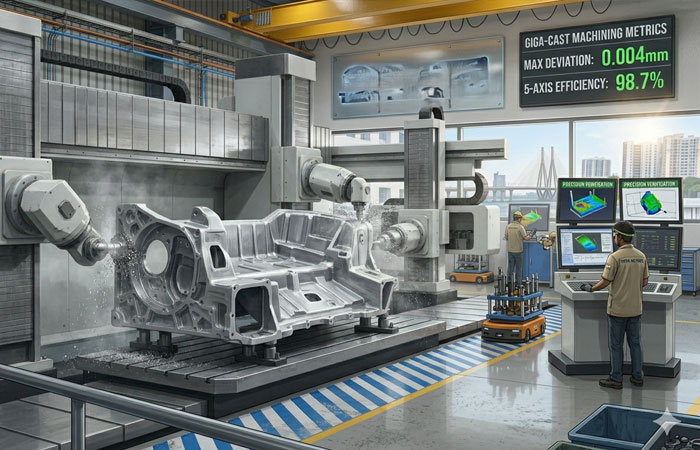
To address these challenges, manufacturers are increasingly investing in specialized large- format 5-axis machining centers designed specifically for giga-casting applications. These advanced machines provide the flexibility and reach required to machine complex geometries in a single setup while maintaining exceptional precision. Unlike conventional machining systems, these platforms feature oversized work envelopes, reinforced machine structures, and advanced thermal compensation technologies to ensure stability during long machining cycles.
The adoption of 5-axis machining has become essential because giga-cast parts contain features located at multiple angles and depths. Simultaneous multi-axis movement allows tools to approach difficult areas efficiently while minimizing repositioning errors. Single-setup machining also reduces tolerance stack-up, ensuring consistent dimensional accuracy across the entire casting.
Another major challenge lies in tooling. Since giga-cast structures can span the length of an automotive chassis, manufacturers often require ultra-long reach cutting tools to access deep cavities and internal features. However, longer tools are naturally more susceptible to vibration and deflection, which can compromise surface finish and dimensional consistency.
To overcome this issue, tooling manufacturers are developing advanced dampened tool holders and lightweight carbide tooling systems capable of maintaining rigidity during extended reach operations. High-performance coatings, optimized flute geometries, and balanced tool assemblies further improve stability while supporting higher spindle speeds and feed rates.
Thermal management also plays a crucial role in giga-casting machining. Continuous high-speed machining of large aluminum structures generates substantial heat, which can impact both tool life and dimensional accuracy. Modern machining centers therefore incorporate intelligent coolant delivery systems, thermal sensors, and real-time monitoring technologies to maintain process stability throughout the operation.
Automation is another critical factor driving productivity in giga-casting environments. Robotic loading systems, automated inspection stations, and in-process measurement technologies are increasingly integrated into machining cells to ensure repeatability and reduce manual intervention.
As EV manufacturers continue pushing toward faster production and lighter vehicle architectures, giga-casting is set to become a defining technology of the automotive industry. Yet behind every successful gigacast component lies a sophisticated machining process that transforms these enormous aluminum structures into precision-engineered chassis systems.
In many ways, giga-casting is not eliminating machining—it is elevating it to an entirely new level of complexity, precision, and technological innovation.