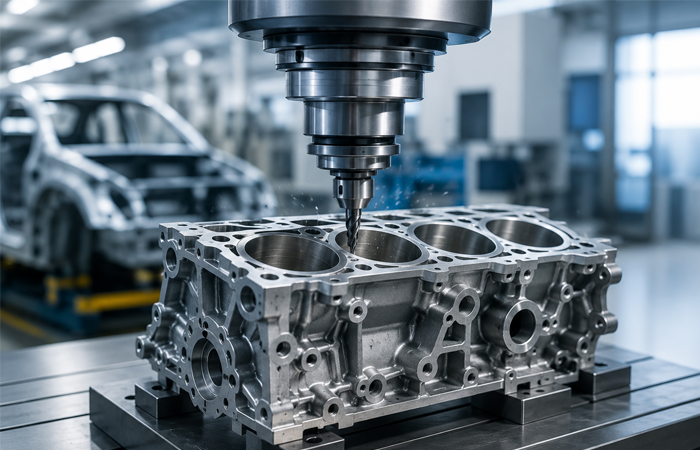
The global automotive landscape is moving through one of its most transformative phases in history. As the industry straddles the line between internal combustion engines (ICE) and electric drivetrains, the silent backbone supporting this evolution is the automotive machining industry.
In 2026, precision machining is no longer just about cutting metal; it is about micron-level geometric tolerances, smart factory integrations, and reshaping manufacturing to support lighter, more efficient vehicles. Driven by massive capacity expansions and structural shifts like the “China Plus One” strategy, the machining sector is experiencing a significant growth super-cycle.
Global Market Growth Trajectory
The global automotive machining market enters 2026 with incredible momentum. Advanced component manufacturing demands are shifting toward high-mix, flexible production lines to handle both hybrid and battery electric vehicle (BEV) platforms.
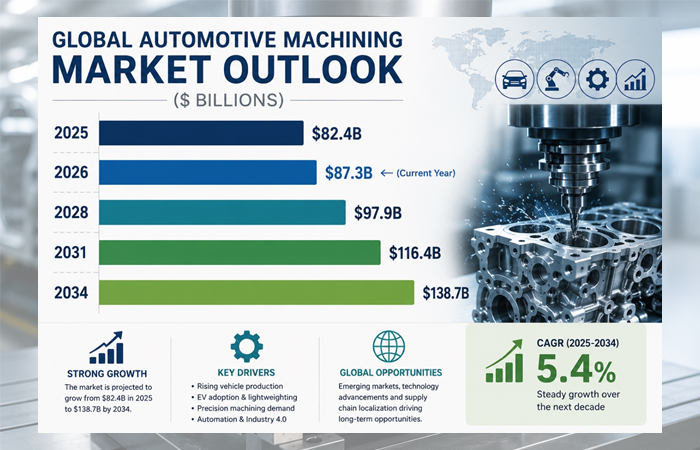
According to data tracking the manufacturing equipment and machining sectors, the specialized global automotive machining market is valued at $87.3 billion in 2026, on a steady march to reach $138.7 billion by 2034 at a compound annual growth rate (CAGR) of 5.97%.
The EV Precision Paradox
While early industry fears predicted that a drop in traditional engine parts (like cylinder heads and pistons) would decimate machining, the reality in 2026 is a “precision paradox.” EVs require fewer moving components, but the components they do need call for significantly higher machining intensity.
EV single-speed reducers, permanent magnet rotor cores, motor end shields, and complex internal inverter cold plates require extreme geometric accuracies. Industry data reveals that the machining intensity per unit value for EV-specific parts is 22% to 28% higher than traditional ICE parts due to strict noise, vibration, and harshness (NVH) requirements.
The Indian Market: Hyper-Growth on the Horizon
India has emerged as the fastest-growing regional precision machining market globally. Valued at approximately $6.56 billion at the turn of the year, India’s precision machining ecosystem is projected to reach $16.60 billion by 2033, compounding at a staggering 12.4% CAGR.
Auto Component Exports: Sourcing Pivot to India
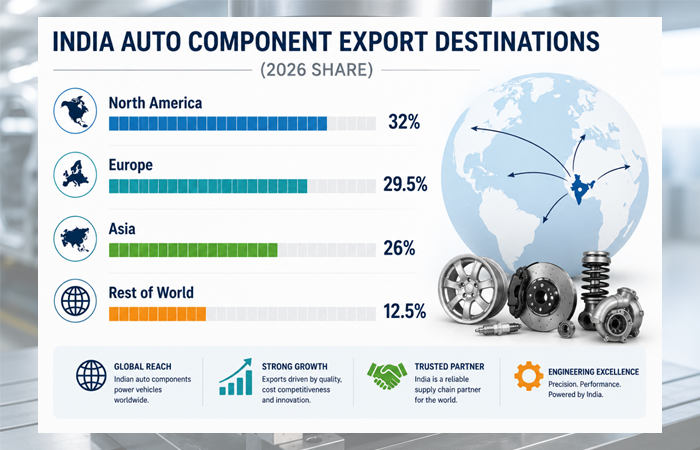
India is firmly cementing its position as a reliable global Tier-2 sourcing hub, actively capitalizing on global supply chain diversification. The country exported $22.9 billion worth of auto components in the last full fiscal year, and despite global macroeconomic headwinds, exports rose 9.3% in H1 FY26 to $12.1 billion.
Indian machining firms are shipping critical, high-value components globally:
- Engine & Drivetrain: Machined steel forgings, crankshafts, and ventilation brake discs.
- Next-Gen Tech: E-axles, aluminum die-cast housing units, and EV traction motors.
- Major Global Buyers: Tier-1 suppliers and OEMs in the United States ($7B+ market share), Germany, the UK, and Turkey.
Future Investment Opportunities
The intersection of government backing and shifting tech platforms creates lucrative entry points for investors in 2026.
Advanced CNC and “Lights-Out” Manufacturing
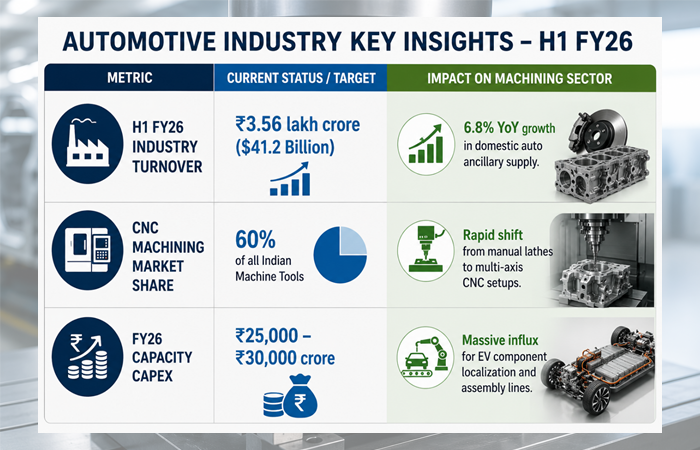
Computerized Numerical Control (CNC) machinery accounts for over 60% of the active machine tool market. The ultimate manufacturing goal is lights-out manufacturing—fully automated factories utilizing robotic arm loaders and real-time digital twins. Industry data shows that integrating automated tool changes and digital twin simulations has successfully slashed prototyping costs by up to 15% while boosting high-volume production rates by over 20%.
Capitalizing on Policy Support
The Indian government’s PLI-Auto Scheme (Production Linked Incentive), holding an outlay of ₹25,938 crore, has successfully attracted cumulative investments of ₹35,657 crore into advanced automotive technology. Furthermore, the Union Budget 2026-27 expanded the Electronics Components Manufacturing Scheme to ₹40,000 crore and heavily rolled out custom duty exemptions on critical EV raw materials and lithium-ion battery processing machinery.
Advanced Metals and Lightweight Composites
With the massive push for vehicle weight reduction to increase EV range, machining centers are shifting from heavy iron castings to complex aluminum-silicon alloys and magnesium components. Firms offering specialized high-torque, high-speed spindles tailored for non-ferrous precision machining are seeing overwhelming backlogs of orders.
The Road Ahead
The automotive machining industry in 2026 has officially decoupled from its total dependency on the combustion engine. By adapting to the tighter tolerances of electric drivetrains and embedding Industry 4.0 principles into the shop floor, global machining providers are securing stable, long-term revenue growth. Supported by aggressive domestic policies, robust export demand, and deep-rooted manufacturing hubs, India is firmly positioned to sit at the high table of global precision engineering for the decade to come.