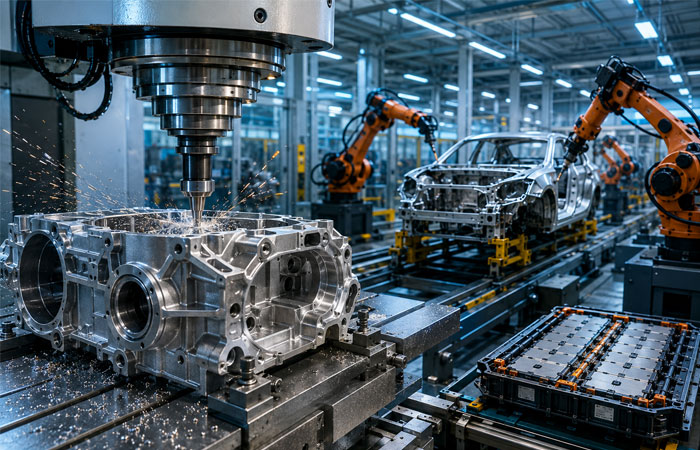
The sound of manufacturing is changing. Across industrial corridors in Pune, Chennai, Bengaluru, and Coimbatore, the thunderous noise of internal combustion engine production is steadily giving way to the sharp, high-frequency hum of electric drivetrain manufacturing. The transformation is not merely about replacing fuel-powered vehicles with electric mobility—it is redefining the very nature of machining, tooling, and precision engineering.
As the global automotive industry accelerates toward electrification, machining companies are experiencing one of the biggest technological transitions in modern manufacturing history. Electric vehicles (EVs) demand fewer mechanical components than traditional vehicles, yet they require far higher levels of precision, lightweight engineering, and advanced machining capabilities. For India’s manufacturing sector, this shift has opened the door to unprecedented opportunities.
Global Ev Growth Is Reshaping Machining Requirements
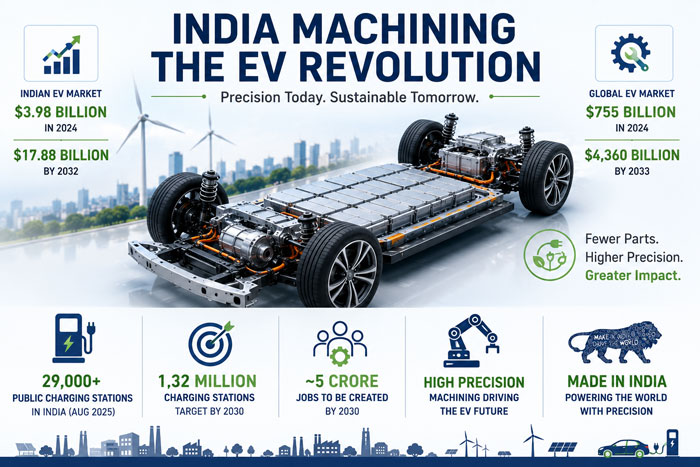
The global EV market, valued at nearly $755 billion in 2024, is projected to surge beyond $4.3 trillion by 2033. This extraordinary growth is driving a complete rethinking of machining strategies worldwide. Unlike conventional internal combustion engine vehicles that contain nearly 2,000 moving components, EVs operate with significantly fewer moving parts. However, the reduced quantity has dramatically increased the demand for precision, efficiency, and high-performance materials.
Modern EV manufacturing revolves around lightweight structures, high-speed motors, battery systems, and thermal management technologies. This has accelerated the adoption of high-speed machining (HSM), 5-axis machining centers, hard turning, and advanced cutting tool technologies across the globe. Materials such as aerospace-grade aluminum alloys, copper, composites, and carbon-fiber-reinforced polymers are becoming increasingly common in EV production, pushing machining companies toward new levels of technical sophistication.
India Emerging As A Global Ev Manufacturing Hub
India is rapidly positioning itself as a major EV manufacturing destination. Backed by government initiatives such as the Production Linked Incentive (PLI) scheme and PM E-DRIVE program, the country is witnessing aggressive investments in EV manufacturing and component localization.
The Indian EV market, valued at nearly $4 billion in 2024, is projected to cross $17 billion by 2032. This growth is fueling massive investments in machining infrastructure, automation, tooling technologies, and smart manufacturing systems.
The most remarkable aspect of India’s EV journey is the growing emphasis on localization. Earlier, manufacturers largely depended on imported assemblies and kits. Today, Indian machining companies are increasingly producing the core components of EVs domestically—from battery housings and motor casings to precision shafts, gears, and cooling systems.
Two-Wheeler And Passenger EV Segments Driving Demand
India’s dominance in the electric two-wheeler segment has significantly accelerated machining demand. Companies such as Ola Electric and Ather Energy are generating enormous requirements for high-precision machined components including hub motors, lightweight aluminum frames, and compact drivetrain systems. At the same time, the electric passenger vehicle segment is expanding rapidly with leaders such as Tata Motors and Mahindra Electric Origin SUVs introducing advanced EV platforms. These developments are encouraging Indian die-mould makers and tool manufacturers to develop complex geometries for aerodynamic body structures, cooling channels, and battery pack systems.
Thin-Walled Aluminum Machining Becomes Critical
One of the biggest trends transforming EV machining is the increasing use of thin-walled aluminum structures. Since vehicle weight directly impacts battery range, manufacturers are aggressively focusing on lightweight engineering.
Battery trays, motor housings, and EV chassis components now require extremely thin aluminum walls with exceptional rigidity and dimensional stability. Machining such components is highly challenging because thin sections are vulnerable to vibration, thermal distortion, and deformation during cutting operations.
To overcome these challenges, manufacturers are adopting vibration-damped tooling systems, optimized toolpath strategies, and high-speed spindle technologies. Indian machining companies that once specialized in heavy engine block manufacturing are now mastering ultra-precision aluminum machining for advanced EV applications.
Rise of Hard Machining And Precision Finishing
Electric motors operate at significantly higher rotational speeds compared to traditional engines, often exceeding 15,000 RPM. At such speeds, even small dimensional inaccuracies can result in excessive noise, vibration, and performance losses.
This has accelerated the adoption of advanced machining processes such as hard turning, power skiving, precision grinding, and super-finishing. Technologies once associated mainly with aerospace manufacturing are now becoming common across automotive machining facilities in India.
This transition is also driving innovation in across India’s manufacturing ecosystem. In many advanced facilities, machining simulations are conducted virtually before actual production begins. This allows manufacturers to optimize cycle times, reduce tool wear, minimize scrap rates, and improve overall productivity.
Predictive maintenance systems are proving especially valuable. Real-time monitoring of spindle performance, cutting forces, and vibration patterns helps manufacturers identify potential machine failures before they occur, reducing downtime and improving operational efficiency.
Ev Infrastructure Boosting Manufacturing Confidence
India’s rapidly expanding EV charging infrastructure is further strengthening confidence in long-term manufacturing investments. Last year, the country had already crossed 29,000 public charging stations, with Maharashtra and Karnataka leading infrastructure deployment. This infrastructure growth is encouraging machining companies to invest aggressively in advanced CNC machines, automation systems, and next-generation production technologies. States such as Tamil Nadu and Maharashtra are emerging as major EV manufacturing clusters, attracting both domestic and international investments.
Bridging The Skill Gap For The Next Industrial Era
Despite the strong momentum, the industry faces a major challenge—the growing skill gap. EV-focused manufacturing requires engineers capable of handling advanced CNC systems, automation software, CAD/CAM integration, and precision process optimization.
The transition from conventional machining practices to high-speed, high-precision EV production demands continuous upskilling and technical training. Industry-academia collaboration and advanced technical education will therefore play a crucial role in sustaining India’s manufacturing competitiveness.
India’s Machining Industry Is Entering A New Era
India is no longer merely participating in the global automotive transformation—it is actively shaping it. Across industrial zones in Chakan, Hosur, Sriperumbudur, and Sanand, the glow of CNC control panels reflects a new industrial reality.
Every chip produced on these shop floors represents more than machined metal; it represents India’s growing capability to lead in the electric mobility era. The EV revolution is not simply changing vehicles—it is redefining the future of machining itself.