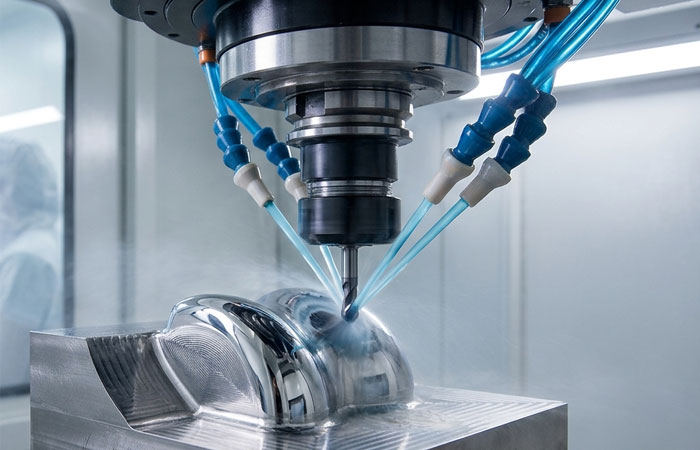
The manufacturing of medical implants—ranging from titanium bone screws to cobalt-chromium hip joints—demands an extraordinary level of precision. Because these devices are placed directly inside the human body, the machining process must balance extreme physical performance with stringent biocompatibility requirements. Central to achieving this balance are metalworking fluids (MWFs). However, selecting and managing coolants and lubricants for implant machining presents a unique challenge: maintaining process stability while completely eliminating the risk of biological contamination.
The Economic and Mechanical Stakes
In high-precision manufacturing, cutting fluids are critical for managing friction and dissipating the immense heat generated when cutting tough, medical-grade biomaterials like titanium alloys (e.g., Ti-6Al-4V). Studies indicate that conventional fluid management represents a substantial financial investment, accounting for 7% to 17% of total machining costs—a figure that frequently surpasses the cost of the cutting tools themselves (typically around 2% to 7%).
Without adequate cooling, the high temperatures generated during the subtractive manufacturing of implants cause rapid tool wear, poor dimensional accuracy, and catastrophic microstructural alterations to the implant’s surface. For medical devices, even minor thermal damage can compromise the structural integrity of the implant, leading to premature failure inside a patient.
The Bio-Compliance Hurdle: The Risk of Conventional Fluids
While traditional mineral oil-based emulsions effectively protect tools and lower temperatures, they pose severe compliance and health risks. In industrial settings, conventional cutting fluids are responsible for approximately 80% of occupational skin diseases (such as dermatitis) among machine operators due to the mist and fumes they generate.
More critically for the medical sector, traditional fluids often contain sulfur, chlorine, phosphorus, and heavy-metal extreme-pressure (EP) additives. If residues from these chemicals leach from a poorly cleaned implant into a patient’s body, they can trigger:
- Severe inflammatory responses
- Cytotoxicity (cell damage)
- Chronic tissue rejection
Consequently, regulatory bodies like the FDA mandate rigorous, multi-stage cleaning validation processes. To minimize this cleaning burden, the industry is shifting toward synthetic, ester-based, or vegetable-oil-derived lubricants that are naturally biodegradable and completely free of toxic additives.
Modern Trends: MQL and Cryogenic Cooling
To mitigate both environmental risks and the immense cost of fluid disposal—which can be up to double the original machining cost—the medical manufacturing industry is rapidly adopting sustainable cooling architectures:
- Minimum Quantity Lubrication (MQL): Instead of flooding the workspace, MQL systems deliver a precise aerosol mist of biodegradable oil directly to the cutting zone. This reduces fluid consumption by up to 95%. When enhanced with nano-additives (Nano-MQL), studies show that surface roughness can be reduced by 34% and tool wear by over 37% compared to dry machining conditions.
- Cryogenic Machining: Utilizing liquid nitrogen ($LN_2$) or compressed carbon dioxide ($CO_2$) at sub-zero temperatures allows manufacturers to eliminate liquid residues entirely. The cryogenic fluid evaporates instantly upon contact, leaving a perfectly clean, dry implant that requires minimal post-process chemical washing.
As the medical implant sector evolves, the fluids used to shape these life-changing devices must evolve alongside them. By transitioning from toxic flood coolants to advanced MQL and cryogenic systems, medical manufacturers can simultaneously protect operator health, lower production costs, and guarantee the absolute biological purity of the final implant.