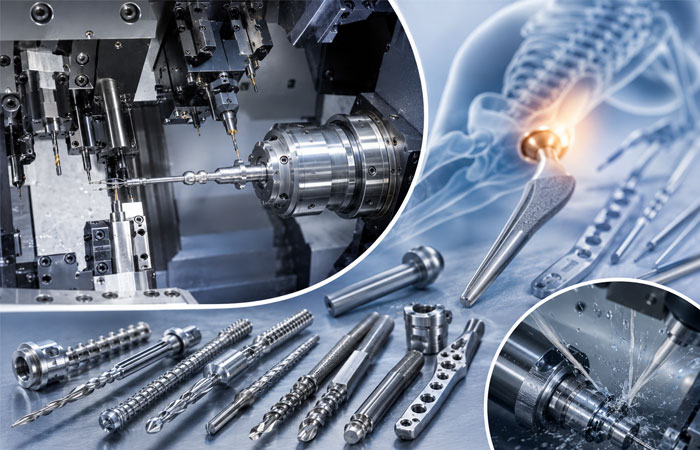

Precision Manufacturing for the Medical Industry
Medical device machining is one of the most demanding areas of modern manufacturing. Components such as orthopedic implants, surgical instruments, dental implants, trauma fixation systems, and diagnostic equipment require extremely tight tolerances, superior surface finishes, and consistent dimensional accuracy. Since these products directly impact patient safety and clinical outcomes, manufacturers must adhere to stringent quality standards and regulatory requirements.
The process of manufacturing medical devices typically begins with a design concept and progresses through engineering validation, material selection, machining, finishing, inspection, and final assembly. Throughout this journey, precision machining plays a vital role in transforming raw materials into complex, highly accurate medical components.
As medical devices continue to become smaller, more intricate, and functionally advanced, conventional machining methods are often unable to meet productivity and precision requirements. This has led to the widespread adoption of advanced CNC technologies, particularly Multi-Axis SWISS Automats, which have revolutionized the manufacturing of medical components.
Core Machining Technologies in Medical Manufacturing
Medical manufacturers employ a combination of conventional and advanced machining processes depending on component geometry, material characteristics, and production volumes. However, among the various machining technologies available today, Multi-Axis Machining has emerged as the preferred solution for producing complex medical components.
Modern 5-axis, 6-axis, and 7-axis machines allow cutting tools to approach the workpiece from virtually any direction. This capability significantly reduces setup requirements while enabling intricate geometries to be machined in a single operation. The result is improved accuracy, reduced cycle times, and enhanced process consistency.
These advantages become especially important in medical manufacturing, where even microscopic deviations can affect product performance.
Materials Used in Medical Devices
Medical devices demand materials that are biocompatible, corrosion-resistant, wear-resistant, and mechanically strong. The most commonly used materials include:
- Titanium and Titanium Alloys
- Stainless Steel (particularly 316L)
- Cobalt-Chromium Alloys
- Medical Grade Super Alloys
These materials are selected because of their excellent biological compatibility and long-term performance inside the human body. However, they are also among the most challenging materials to machine due to their toughness, work-hardening characteristics, and heat generation during cutting.
Since many medical components begin as bar stock and involve complex shapes with extremely tight tolerances, Multi-Axis SWISS Automats have become the preferred machining solution for manufacturers worldwide.
SWISS Automats and Their Role in Medical Device Manufacturing
A SWISS-type automatic lathe is a highly precise CNC machine tool in which the bar stock moves longitudinally through a stationary guide bushing while the cutting tools remain fixed.
This design differs significantly from conventional CNC turning centers. The guide bushing supports the material very close to the cutting zone, minimizing deflection and vibration during machining. As a result, long, slender, and miniature components can be machined with exceptional accuracy.
Modern SWISS automats are equipped with 5 to 7 machining axes, live tooling, Y-axis capabilities, C-axis interpolation, and sub-spindles. These features allow complex medical components to be completely machined in a single setup, reducing handling errors and ensuring superior geometric accuracy.
For manufacturers producing orthopedic screws, dental implants, bone fixation devices, and surgical instruments, this capability offers substantial advantages in terms of both quality and productivity.
Key Features and Advantages of SWISS Automats
Stationary Guide Bushing Technology
The guide bushing supports the workpiece directly at the cutting point while the material moves through it. This unique arrangement prevents bending and vibration, particularly when machining long, thin components commonly found in medical devices.
The result is superior dimensional accuracy and improved surface finish.
Advanced Multi-Axis Capability
Modern SWISS machines integrate turning, milling, drilling, tapping, threading, slotting, and contouring operations into a single platform.
With simultaneous movement across multiple axes, complex implant geometries can be produced in one setup, eliminating secondary operations and improving part consistency.
Main and Sub-Spindle Operations
Most advanced SWISS automats feature both a main spindle and a sub-spindle. While the main spindle machines one side of the component, the sub-spindle can simultaneously perform backside machining operations.
This dramatically reduces production time while ensuring complete machining of the component in a single cycle.
Reduced Cycle Times
Through the combination of gang tooling, live tooling, and synchronized spindle operations, SWISS automats can complete highly complex medical components in one continuous unattended cycle.
This significantly improves machine utilization and production efficiency.
The Importance of Quick Tool Change Systems
One of the challenges associated with SWISS automats is the restricted working space available for tool changes. In medical component manufacturing, cycle times are often less than one minute, whereas conventional tool replacement can require three to four minutes or more.
Such downtime can significantly impact overall productivity.
Hydraulic quick-change tool holding systems provide an effective solution by reducing tool change times to less than one minute. Besides minimizing machine downtime, these systems also offer superior tool concentricity (TIR), stronger clamping force, and enhanced repeatability.
The benefits include:
- Increased machine productivity
- Reduced setup time
- Improved tool life
- Better surface finish
- Higher dimensional accuracy
- Greater process consistency
For high-volume medical manufacturing, these improvements directly contribute to lower production costs and improved quality.
QR Code for Video Demonstration

Video Link:
https://youtu.be/iHFsyjFLv0U?si=VK8LGVbAyQT7C27R
Common Applications of SWISS Automats
Originally developed in Switzerland during the nineteenth century for manufacturing miniature watch components, SWISS automats have evolved into one of the most important machine tools for precision engineering industries.
Medical Devices
- Orthopedic Bone Screws
- Dental Implants
- Trauma Fixation Components
- Surgical Instruments
- Minimally Invasive Surgical Devices
- Spine Implant Components
Aerospace
- Precision Engine Components
- Hydraulic System Parts
- Electronic Connectors
- Sensor Components
Electronics and Automotive
- Electrical Connectors
- Sensor Bodies
- Precision Pins
- High-Volume Micro Components
The increasing complexity of modern medical devices demands manufacturing technologies capable of delivering exceptional precision, repeatability, and productivity. Multi-Axis SWISS Automats have emerged as a transformative solution by enabling complete machining of complex medical components in a single setup while maintaining micron-level accuracy.
Their ability to machine difficult materials such as titanium, stainless steel, and cobalt-chrome with high efficiency makes them indispensable for orthopedic, dental, and surgical device manufacturing. When combined with advanced quick-change tooling systems, these machines further enhance productivity, tool life, surface finish quality, and process reliability.
As the global medical device industry continues to grow and evolve, Multi-Axis SWISS Automats will remain a cornerstone technology for manufacturers seeking world-class precision and operational excellence.