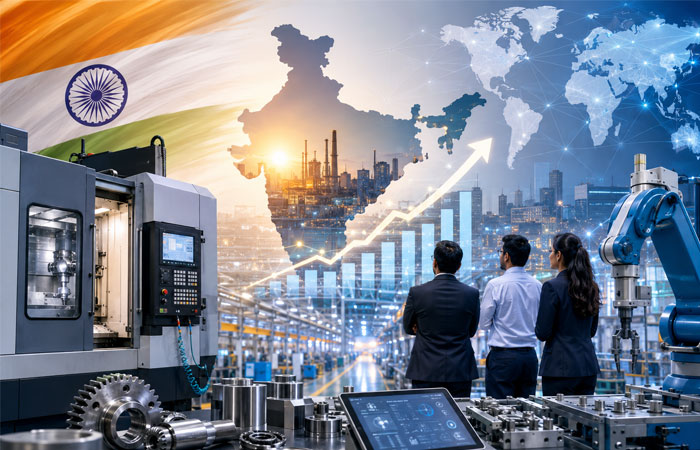

India’s manufacturing and machinery sector continues to strengthen its position as one of the world’s most attractive industrial growth destinations. While geopolitical tensions, tariff-driven supply-chain adjustments, and slowing industrial momentum in parts of Europe have fueled uncertainty across the global economy in the spring of 2026, India remains distinctively resilient. This stability is actively supported by robust domestic demand, expanding industrial investments, and proactive federal industrial policies.
According to the latest VDMA (German Engineering Federation) India Business Climate Survey, conducted from April 20 to May 4, 2026, among 85 member companies, engineering and equipment manufacturers operating within the country maintain an optimistic outlook. The empirical findings reveal that international firms no longer view India merely as a low-cost manufacturing location, but rather as a vital, strategic hub to diversify global operations and build regional supply chain hedges.
India Emerging as a Strategic Manufacturing Hub
The momentum characterizing India’s manufacturing ecosystem is fundamentally driven by large-scale infrastructure development, rising domestic consumption, accelerated factory automation, and federal initiatives like the Production Linked Incentive (PLI) schemes. This industrial drive is heavily backed by the government’s historic ₹12.2 lakh crore ($146.5 billion) public capital expenditure allocation for FY 2026-27—representing a 9% year-on-year increase intended to rapidly upgrade national logistics.
Complementing this, India’s estimated real GDP growth of 7.6% for FY 2025-26 stands out as a global bright spot, reinforcing long-term investment confidence among machinery providers. This growth trajectory is highly visible across core sectors, including:
- Heavy Construction Equipment: A market that reached $15.37 billion in 2025 and is projected to scale to $29.50 billion by 2034, moving at a 7.52% CAGR.
- Heavy Machinery Components: Valued at $5.3 billion in 2025 and anticipated to touch $9.1 billion by 2034.
- Advanced Manufacturing Systems: High demand for Computer Numerical Control (CNC) automation, precision engineering, and specialized electrical systems as local facilities aggressively expand capacities.
Business Sentiment Continues to Improve
The quantitative metrics from the VDMA survey highlight a distinct upward shift in executive confidence regarding the local operating environment.
| Business Condition Rating | Share of Respondents | Shift from Previous Survey |
| Good | 36% | Up from 29% |
| Satisfactory | 54% | Down from 63% |
| Poor | 9% | Minimal Change |
This sentiment is strongly mirrored in manufacturing health. Factory capacity utilization numbers remain highly stable: 66% of surveyed companies report operating at normal capacity levels, 22% indicate above-normal utilization, and only 12% are operating below normal levels (improving from 17% in the prior cycle). Strong order books reinforce this stable outlook, with 38% of respondents operating with above-normal order pipelines. Furthermore, nearly two-thirds of the companies anticipate an influx of incoming orders over the upcoming three months.
Domestic Demand Driving Industrial Growth
A foundational pillar of India’s machinery sector is its structural reliance on domestic absorption. While export-dependent industrial economies navigate stagnating capital expenditures, India’s engineering suppliers continue to benefit from multi-sector internal investments spanning automotive, aerospace, medical devices, defense, and green energy infrastructure.
[CEV Stage V Emission Norms Implementation]
|
▼
[Strict Environmental & Sustainability Regulations]
|
▼
[Accelerated Demand for Clean Propulsion Systems]
|
▼
[Projected $3.64 Billion Electric Equipment Market by 2034]
Technology adoption is acting as a major multiplier. The implementation of CEV Stage V emission norms has forced a technological shift toward clean propulsion. Although electric and hybrid variants made up just 5.28% of total equipment shipments recently, the electric construction equipment segment alone is scaling at a 22.14% CAGR, on track to reach $3.64 billion by 2034. Additionally, localized manufacturing of high-capacity equipment is hitting milestones; for instance, JCB’s Pune facility recently introduced a 52-tonne excavator—the largest ever built in India—to cater directly to escalating local mining and infrastructure demands.
Positive Outlook for Revenue and Employment
Looking forward into the second half of 2026, future expectations from industrial players remain highly encouraging.
VDMA Key Projections:
- Six-Month Outlook: 57% of surveyed engineering executives expect localized business conditions to improve further, while 40% anticipate market stability.
- Headcount Expansion: 44% of companies are actively planning to expand their workforce to sustain growth.
- Revenue Forecasts: Machinery manufacturers project a robust nominal revenue growth of approximately 11% for FY 2025-26, followed closely by a targeted 10% growth rate for FY 2026-27.
This hiring and revenue momentum underscores that European and international subsidiaries are confidently aligning their corporate sales and localization strategies with India’s long-term industrial policy priorities.
Challenges and Opportunities Ahead
Despite prevailing optimism, the industrial machinery sector is not entirely immune to operational headwinds. Global supply-chain fragmentation continues to exert pressure, with 14% of surveyed companies identifying persistent raw material and components shortages as a primary operational bottleneck. Furthermore, a minor 13% of respondents noted occasional project delays due to a temporary lack of immediate orders in specific niches, such as non-automated machine tools.
Nevertheless, the baseline data suggests that India’s domestic industrial ecosystem remains structurally sound and highly growth-oriented compared to global peers. Looking ahead, the potential conclusion and ratification of the ongoing EU-India Free Trade Agreement (FTA) negotiations stands out as a highly anticipated macroeconomic tailwind. Successful execution of the FTA will substantially lower trade barriers, streamline regulatory compliance, and ease import workflows for critical high-tech components.
Backed by consistent federal capital expenditure outlays, an improving business climate, and a massive domestic consumption market, India is securely positioned to anchor itself as the preferred, resilient destination for global machinery and equipment enterprises through 2026 and well into the next decade.