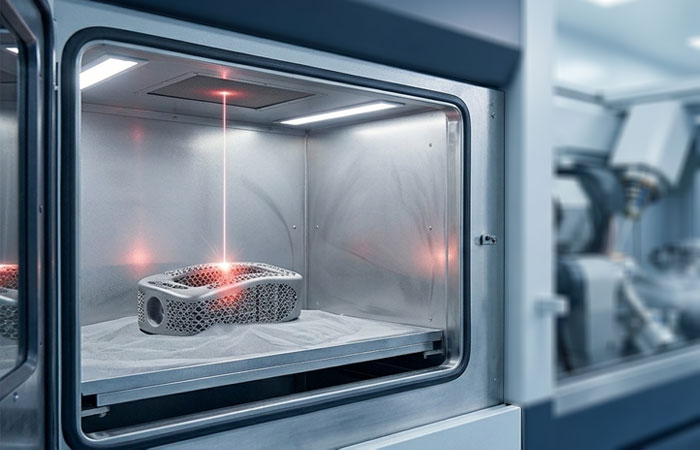
The medical device landscape is undergoing a profound digital transformation. Driven by an aging population and a rising preference for personalized healthcare, the global 3D-printed medical implants market has grown to $2.98 billion. Expanding at a compound annual growth rate (CAGR) of 16.2%, the sector is projected to exceed $11.67 billion over the next decade.
At the core of this massive expansion is the transition away from standardized, “one-size-fits-all” prosthetics toward patient-specific solutions. To achieve this economically and at scale, manufacturers are increasingly turning to hybrid production—a powerful manufacturing workflow that pairs the design flexibility of additive manufacturing (AM) with the geometric perfection of subtractive precision machining.
Why Additive Manufacturing Dominates Orthopedics
Orthopedic applications—such as customized hip, knee, and spinal implants—represent the largest segment of the 3D-printed implant industry, accounting for 53% of the total market share.
| Key Statistic | Market Metric |
| $2.98 Billion | Global 3D-Printed Implant Market Size |
| 16.2% | Projected Market CAGR (through 2035) |
| 53% | Orthopedic Segment Market Share |
| 35% | Market Share of Metal-Based (Titanium) 3D Printing |
Traditional subtractive manufacturing struggles to create the complex, highly porous structures needed for modern bio-implants. Technologies like Laser Beam Melting—which holds a commanding 47.5% share of the printing technology market—allow advanced metals like titanium alloys to be printed with complex latticework.
These porous surfaces closely mimic human trabecular bone, encouraging natural bone ingrowth (osseointegration). This structural advantage radically minimizes the risk of implant migration or early joint failure, cutting down on painful revision surgeries.
The Critical Need for Hybrid Production
Despite its incredible strengths, 3D printing is rarely a standalone solution for final implant production. Components direct from a 3D printer typically exhibit a stepped surface finish and lack the microscopic dimensional tolerances required for high-stress interfaces. An artificial hip ball joint, for instance, cannot function with a rough, printed exterior; it requires a mirror-like finish to eliminate friction.
This is where hybrid production becomes essential. The manufacturing sequence follows a strict, highly integrated path:
- Additive Phase: The internal bone-mimicking porous lattice and the general geometry of the implant are printed.
- Subtractive Phase: The implant is transferred to a precision CNC machining or grinding center. High-precision tools finish the critical mating surfaces, thread joints, and sealing faces to micrometer-level accuracy.
This combined architecture capitalizes on the strengths of both words: the infinite geometric freedom of additive manufacturing and the absolute accuracy of precision machining.
The pairing of 3D printing and precision machining represents the future of medical device fabrication. By fusing these two once-competing technologies into a unified hybrid production pipeline, the medical industry successfully achieves the holy grail of MedTech: producing affordable, highly customized implants that fit a patient’s exact anatomy while guaranteeing the flawless surface integrity required for a lifetime of performance.